
Fundamentals 7 min read
Golf Club Lofts and Distances: What a Degree Is Worth
One degree of loft is worth about three yards of carry. See iron lofts by club across three eras, and why a modern 7-iron matches a 1980s 5-iron.
By Garrett Pierson
Quick answer
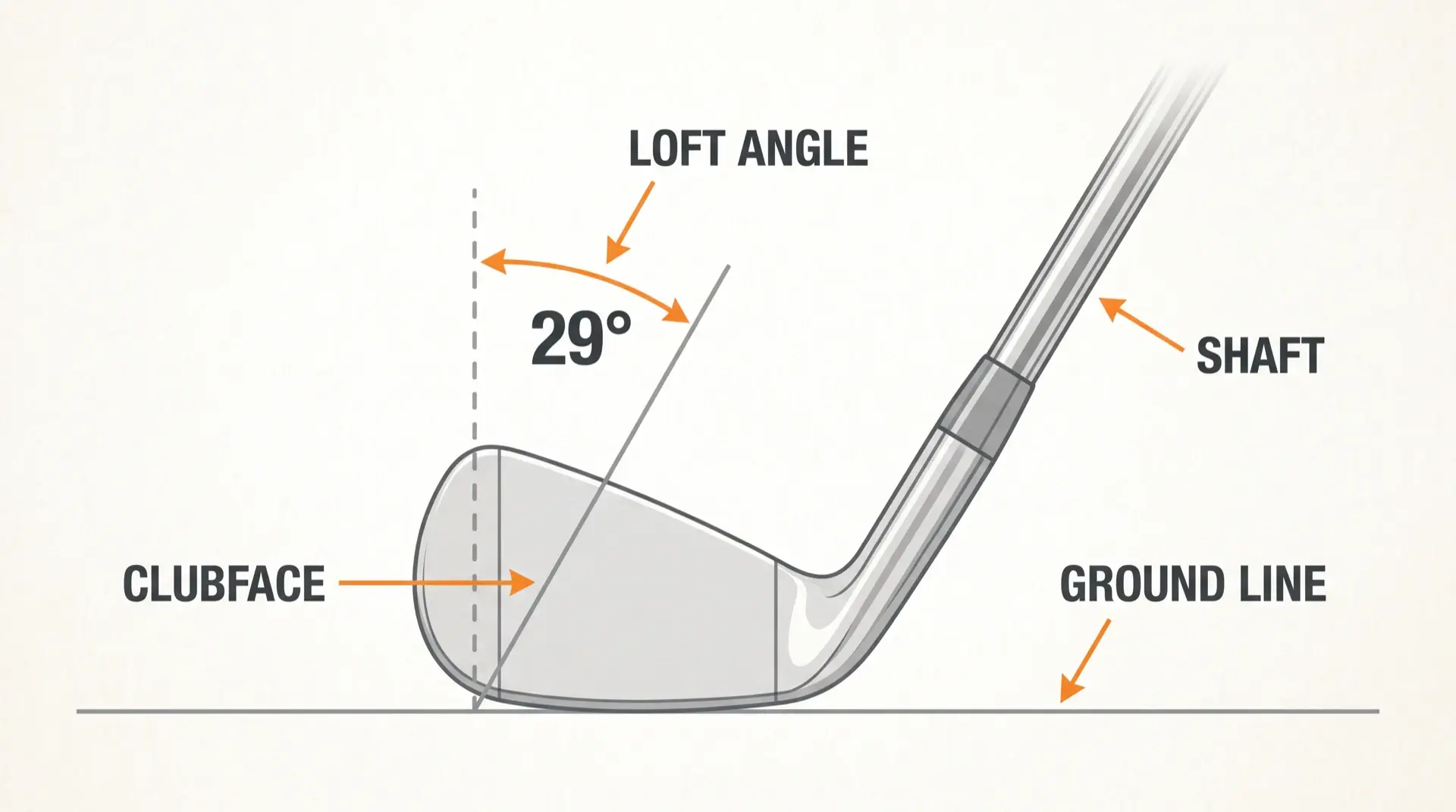
One degree of loft is worth about three yards of carry, so the traditional four-degree step between irons buys roughly 12 yards. Modern sets broke that arithmetic. A Ping G440 7-iron is 29 degrees, within half a degree of the Ping Eye 2 5-iron from 1982. Look up your real lofts before you trust any distance chart against your own bag.
Iron lofts by club: three sets, one brand
Same manufacturer, three eras, the number on the sole held constant:
| Club | Ping Eye 2 (1982) | Ping i230 (players) | Ping G440 (game improvement) |
|---|---|---|---|
| 5-iron | 28.5° | 26° | 22° |
| 6-iron | 32° | 29.5° | 25.5° |
| 7-iron | 36° | 33° | 29° |
| 8-iron | 40° | 37° | 33° |
| 9-iron | 45° | 41° | 37° |
| Pitching wedge | 50.5° | 45° | 42° |
Sources: Ping G440 specs, Ping i230 specs, Ping Eye 2 lofts.
The drift grows the further down the set you look. Between 1982 and 2025 the 5-iron moved 6.5 degrees. The pitching wedge moved 8.5. And the two sets Ping sells today sit four degrees apart at the numbered irons, three at the pitching wedge.
So a golfer playing i230s and a golfer playing G440s are holding different clubs when they both pull “7-iron.” That’s before either of them swings.
What one degree of loft is worth
About three yards of carry. MyGolfSpy uses that figure as its gapping baseline: “One degree of loft typically works out to about three yards of carry distance so, if you have four degrees of loft between clubs, a 12-yard gap is a solid target.” Twelve yards sits comfortably inside the 10 to 15 yards fitters look for between consecutive clubs.
Run it in both directions:
| Loft step | Expected carry gap |
|---|---|
| 1° | 2 to 3 yards |
| 3° | ~9 yards |
| 4° | ~12 yards |
| 5° | ~15 yards |
| 8° | ~24 yards, two clubs |
| 14° | ~40 yards, a hole in the bag |
The rule earns its keep inside one set, where the head design and shaft stay the same from club to club and the length steps evenly, which leaves loft doing most of the work. Push it across two different models and it starts lying to you.
Loft alone doesn’t explain modern distance
MyGolfSpy tested four irons all stamped 7, with shaft lengths within a quarter inch of each other:
| 7-iron | Loft | Ball speed | Launch | Backspin | Carry |
|---|---|---|---|---|---|
| Yonex N1-MB | 35° | 105.5 mph | 21.53° | 7,070 rpm | 142 yds |
| Ping iBlade | 34° | 107.3 mph | 21.18° | 6,746 rpm | 146 yds |
| Callaway Apex CF 16 | 31° | 110.1 mph | 20.32° | 5,510 rpm | 155 yds |
| PXG 0311XF | 30° | 113.7 mph | 20.16° | 5,372 rpm | 161 yds |
Five degrees of loft, 19 yards of carry. That is 3.8 yards per degree, running hot against the three-yard rule, and at first glance it reads as loft doing all the work.
The launch column says otherwise. Five degrees of static loft produced a launch difference of 1.37 degrees, and MyGolfSpy reports the strongest-lofted club of the four also flew the highest peak. Ball speed climbed 8 mph across those same four clubs. The center of gravity in the game-improvement heads sits lower and deeper, which adds dynamic loft back at impact, so the launch angles barely separate despite a 5-degree spread on paper.
MyGolfSpy’s analysis of 102,244 tracked shots puts numbers on the same effect. Player’s distance irons carried 6.3 yards farther than player’s irons at the 7-iron, delivering 1.90 degrees less loft at impact.
If loft were the entire explanation, peak height should have dropped 0.95 yards. It dropped 0.18. Landing angle should have gone 1.51 degrees shallower. It went 0.88.
The extra ball speed is buying back the flight the stronger loft costs. That’s why a modern 29-degree 7-iron doesn’t fly like a knife, and it’s also why you can’t convert loft to yards across brands with a calculator.
Where extra loft stops buying yards
Loft is a distance lever at the top of the bag and a control lever at the bottom. TrackMan’s launch angle data shows the crossover: a driver at 94 mph launches at 13.6 degrees, a 6-iron at 80 mph launches at 16.9, and a pitching wedge at 72 mph launches at 26.7.
By the time you reach the wedges, added loft is spending your ball speed on height and spin instead of carry. That is the point of a wedge. A 60-degree lob wedge trades yards for a steeper landing angle, which is the whole reason it goes in the bag.
The same limit shows up at the other end of the bag. Take enough loft off a long iron and the ball speed gain stops covering the lost launch, so carry flattens out. That’s the gap hybrids exist to fill, and it’s covered in the hybrid distances post.
The hole loft creep leaves under your pitching wedge
Every degree the pitching wedge gains has to come out of somewhere, and it comes out of the space below it.
The 52-56-60 wedge setup that most golfers still buy was built around a set pitching wedge in the high 40s or low 50s, which is where the Eye 2 sat at 50.5. GolfWRX’s Wedge Guy puts today’s number nearer 45, and Ping’s G440 is 42. Put that 42-degree pitching wedge in front of a 56-degree sand wedge and you have 14 degrees in one jump. At three yards per degree, that’s about 40 yards of carry with nothing to hit.
The MyGolfSpy shot analysis found the same problem forming in real bags: 36 percent of the golfers in that analysis gained more than five yards with a strong-lofted pitching wedge. Any golfer who kept their existing wedges added every one of those yards straight onto the gap below, since the sand wedge never moved.
Ping’s answer is the 47-degree utility wedge it now sells with the G440 set. The wedge distance chart post has the full version of this math, including what the carry gaps measure by handicap.
The last rung stretches too. In the G440 the step from 9-iron to pitching wedge is five degrees, 37 to 42, wider than any step above it in the set. GolfWRX’s Wedge Guy flags the same drift and reckons most amateurs get 15 yards or more out of a five-degree step, right where you need precision most.
What to do with your own lofts
- Find your actual lofts. Look up your exact model and year, not the club number. If your set is more than a few seasons old, the lofts may also have drifted from everyday use.
- Write the ladder down. Every club from lob wedge to driver, loft beside it, in order. Uneven steps are visible in about ten seconds.
- Then measure carry. Loft predicts the gap; your median carry over 8 to 10 normal shots proves it. The measuring method is here.
- Bend for small errors, buy for big ones. One degree buys two to three yards, so bending fixes a 2 to 5-yard mismatch. A gap over 15 yards needs a different club.
The MyBagCaddie bag audit runs that comparison across all 14 clubs and names every gap in yards, so you can size each one against the three-yards-per-degree math above before you spend anything.
For deeper dives
- Golf club distance chart: the full distance-by-handicap table this loft ladder feeds into.
- Golf wedge distances chart: the bottom of the bag in detail, where loft creep does the most damage.
- 7-iron distance: the benchmark club, and why comparing 7-irons across brands is a trap.
- Golf bag setup: which 14 clubs deserve the slots once the loft ladder is even.
Key takeaways
- One degree of loft is worth about three yards of carry; four degrees is about 12 yards, the classic one-club step.
- Ping sells a 33-degree 7-iron and a 29-degree 7-iron at the same time, so the number on the sole tells you which slot the club fills and nothing about its loft.
- A Ping G440 7-iron at 29 degrees is within half a degree of a 1982 Ping Eye 2 5-iron.
- Stronger lofts explain only part of modern distance: across 102,244 shots, peak height fell 0.18 yards where loft alone predicted 0.95.
- Five degrees of static loft moved launch angle only 1.37 degrees in MyGolfSpy’s four-iron test, because head design gives dynamic loft back at impact.
- A strong pitching wedge costs you at the bottom of the bag: a 42-degree wedge in front of a 56 leaves 14 degrees, roughly 40 yards, in one jump.
Frequently asked questions
- How many yards is one degree of loft worth?
- About three yards of carry, which is the working number MyGolfSpy uses for gapping. Four degrees between clubs should produce roughly a 12-yard gap, and that sits inside the 10 to 15 yards fitters aim for. Treat it as a rule of thumb rather than a law. It holds up well inside one set of irons, where the heads and shafts are identical from club to club, and it gets unreliable the moment you compare two different models.
- What are standard golf club lofts?
- There is no standard anymore. Ping's current i230 players iron runs 26 degrees at the 5-iron, 33 at the 7-iron and 45 at the pitching wedge. Ping's G440 game-improvement iron runs 22, 29 and 42 for the same three slots. Both are current, both are the same brand, and they sit four degrees apart at the numbered irons, three at the pitching wedge. The number on the sole names the slot. The loft is a separate fact you have to look up.
- Why is my 7-iron stronger than my dad's 7-iron?
- Iron lofts have been strengthened for four decades so sets test longer against each other. A Ping Eye 2 from 1982 had a 36-degree 7-iron. Ping's G440 7-iron is 29 degrees, which is within half a degree of the Eye 2 5-iron. Seven degrees is roughly two clubs' worth of loft, so the club in your hand sits two rungs lower on the loft ladder than the number on it suggests.
- Does a stronger loft actually make the ball go farther?
- Partly. MyGolfSpy's analysis of 102,244 tracked shots found player's distance irons carried 6.3 yards farther than player's irons at the 7-iron, with delivered loft 1.90 degrees lower. If loft were the whole story, peak height should have dropped 0.95 yards; it dropped 0.18. The faster face is recovering the flight the stronger loft would otherwise cost you.
- What loft gap should I have between clubs?
- Four degrees is the traditional step and still a sound target through the irons, since it lands near a 12-yard carry gap. Plenty of modern sets stretch the 9-iron to pitching-wedge step to five degrees, which GolfWRX's Wedge Guy reckons delivers 15 yards or more for most amateurs. Check the actual carry gap rather than the loft gap. Loft is the input; yards are the answer.
- Why is there a big gap between my pitching wedge and sand wedge?
- Because the pitching wedge moved and the sand wedge did not. The 52-56-60 wedge setup was built around a set pitching wedge in the high 40s or low 50s. A modern game-improvement pitching wedge is closer to 42, so pairing it with a 56-degree sand wedge leaves 14 degrees in one jump, roughly 40 yards of carry with nothing to hit. A gap wedge near 49 degrees splits it into two even steps.
- Should I get my lofts bent?
- It is worth doing when your measured carry gaps are uneven, and a one-degree bend moves a club about two to three yards. Bending fixes small gapping errors. A gap over 15 yards is a missing club, and no amount of loft work will conjure one. Cast irons do not all bend safely, so check with the manufacturer or a fitter before anyone puts your set in the machine.