
Bag setup 10 min read
Golf Bag Setup: How to Choose Your 14 Clubs
How to set up a golf bag that fits your game: what 14 clubs to carry, the yardage gap your handicap needs, and the slots where most bags leak strokes.
By Garrett Pierson
Quick answer
Set up your bag around total range: subtract your sand wedge distance from your driver distance, then divide by 11, the number of steps between those two clubs in a standard bag. That’s the yardage gap you need. A 15 handicap covers 152 yards and needs about 14-yard gaps; a 25 handicap covers 124 and needs 11. Fill the slots to hit those steps, then fix the slots above your 5-iron first.
The 14 slots and what fills them
| Section | Slots | Common build |
|---|---|---|
| Tee clubs | 2 | Driver plus a 3-wood or 5-wood |
| The long stretch | 2 to 3 | Hybrids, higher-lofted fairway woods, or long irons |
| Irons | 5 to 6 | 5-iron or 6-iron through pitching wedge |
| Wedges | 2 to 4 | Gap and sand wedge, plus a lob wedge if you use it |
| Putter | 1 | The one uncontested slot |
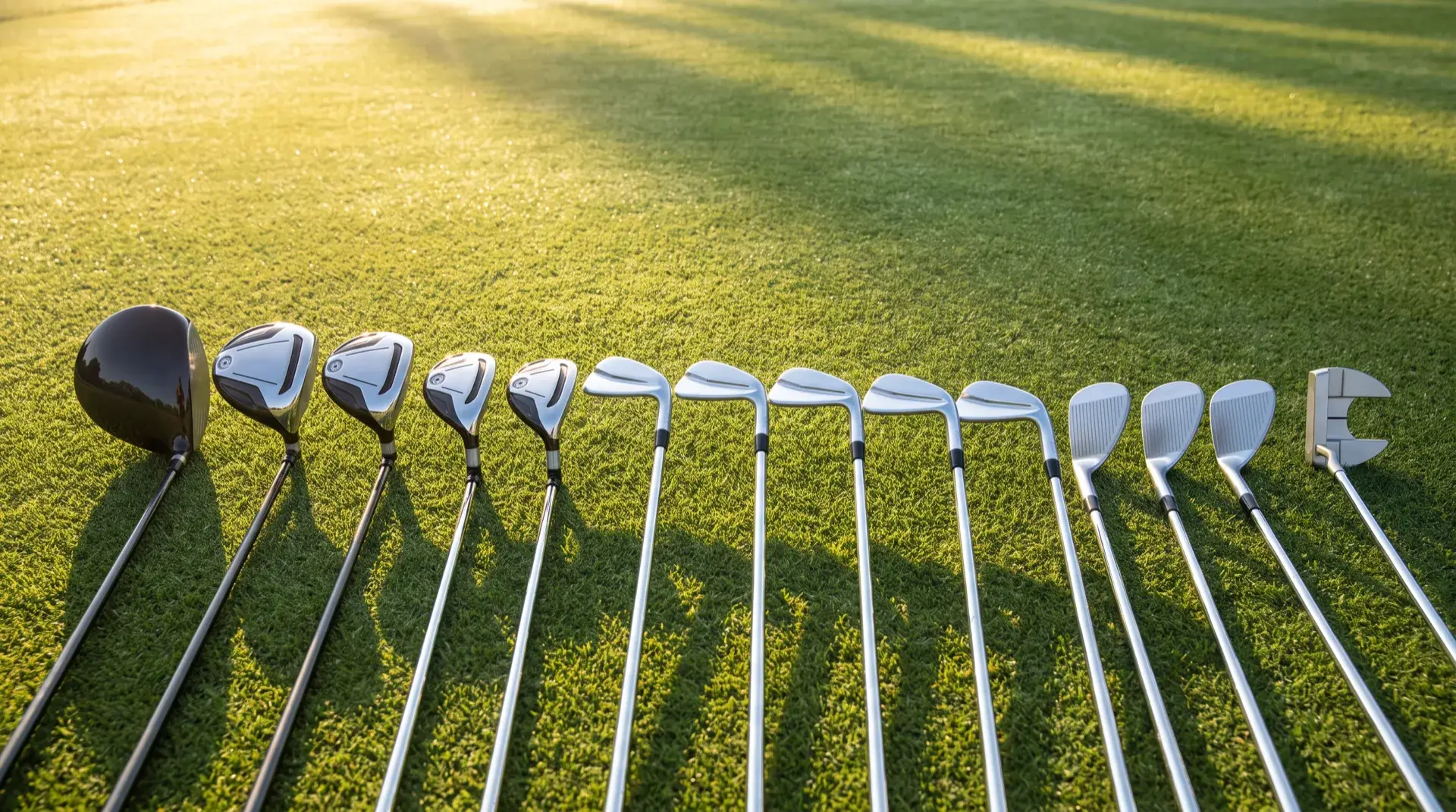
The ranges trade against each other, so pick a set that totals 14. One common build: driver, 3-wood, two hybrids, 5-iron through pitching wedge, three wedges, putter. Add a third club to the long stretch and a wedge comes out. The argument is always about that second row, and the tracked shot data below says the row deserves it.
Start with your total range, because it sets everything else
Your bag has one job: cover every yardage between your longest club and your shortest full swing, with no holes. That distance is different for every golfer, and it’s the number that decides how many clubs you need and how far apart they should be.
MyGolfSpy ran Shot Scope’s tracked distances through exactly this math. A scratch golfer averages 285 yards with a driver and 105 with a sand wedge, leaving 180 yards to fill. A 25 handicap averages 204 and 80, leaving 124.
| Handicap | Driver | Sand wedge | Total range | Gap needed |
|---|---|---|---|---|
| 0 | 285 | 105 | 180 yds | 16 yds |
| 5 | 261 | 86 | 175 yds | 16 yds |
| 10 | 259 | 98 | 161 yds | 15 yds |
| 15 | 236 | 84 | 152 yds | 14 yds |
| 20 | 225 | 85 | 140 yds | 13 yds |
| 25 | 204 | 80 | 124 yds | 11 yds |
Two notes on the columns. The driver figures are Shot Scope performance averages (the club’s typical on-course result) and the sand wedge figures are carry, so read the range as a close estimate. The gap column is our arithmetic: total range divided by 11.
Why 11. Count a standard bag from the top: driver, 3-wood, two hybrids, six irons through the pitching wedge, then a gap wedge and a sand wedge. The sand wedge lands twelfth, which puts eleven steps between it and the driver. A lob wedge sits below the sand wedge, so carrying one or leaving it home doesn’t move the divisor, which is why the 13-club bags in Shot Scope’s data use the same number.
The results run from 11 to 16 yards, straddling the 10-to-15-yard window MyGolfSpy’s fitting guidance points to. Other fitters argue for 8 to 10. Treat the target as a band.
Higher handicaps need tighter steps. Most golfers assume the reverse, which is why a 25 handicap with 11-yard gaps ends up with less room for a redundant club than a scratch player has.
The gap formula that takes ten seconds
Ping’s VP of fitting and performance, Marty Jertson, gives a shortcut that skips the range math entirely: take your 7-iron ball speed in mph and divide it by 10. That number is your target spacing in yards. A 100 mph 7-iron ball speed points to 10-yard gaps; 130 mph points to 13. Treat it as a fitting starting point.
The two methods land close but rarely identical, since one starts from your bag’s span and the other from your speed. Take the smaller of the two as your target, and if either disagrees with your own tracked carries, your carries win. The method for getting those is in how to find your real club distances: 8 to 10 normal strikes per club, throw out the true mishits, take the median.
The slots above your 5-iron decide the most
MyGolfSpy surveyed golfers on what they carry and found the bags of low and high handicaps look nearly identical from the 5-iron down. Almost everyone carries a driver, a 6-iron through sand wedge, and a putter. The real divergence sits in the two or three slots between the longest fairway wood and the 5-iron. MyGolfSpy counts three there for a golfer carrying two wedges past the pitching wedge; make it two if you carry a lob wedge as well.
Those slots go to some mix of fairway woods, hybrids, and long irons. In that survey, published in 2016, the 4-hybrid overtakes the 4-iron once you reach the 16-to-20 handicap band, and 5-hybrid use runs near 20% among 11-to-15 handicaps and around 25% from 16 up. Combined 3-wood and 4-wood carry rates peak just under 95% for the lowest handicaps and fall to 65.8% among 30-plus, where 4-iron use climbs back above 4-hybrid use. Treat the percentages as a decade-old snapshot; the structural point is the one that has held.
Shot Scope’s on-course numbers argue that migration should be faster. Their comparison of hybrids against the matching long irons has hybrids ahead across the board:
| Handicap | Greens hit | Proximity | Dispersion | From rough |
|---|---|---|---|---|
| Scratch | +6% | 11 ft closer | 10 ft tighter | +1 yd |
| 10 | +2% | 14 ft closer | 15 ft tighter | +14 yds |
| 20 | +1% | 16 ft closer | 19 ft tighter | +11 yds |
Their separate iron versus hybrid analysis adds that a hybrid carries 8 to 12 yards farther than the corresponding iron and is close to twice as effective from beyond 200 yards. Shot Scope’s own summary of it is a rule you can apply tonight: don’t carry an iron you hit over 180 yards, swap it for a hybrid.
That’s a rule of thumb with edges. The advantage narrows fast inside 180 yards, and MyGolfSpy’s Shot Scope tables record scratch players hitting slightly more greens with an iron than a hybrid from 175. From 200 yards, every handicap band in those tables hits more greens with the hybrid.
The greens-hit column looks small, and it undersells the result. Proximity and dispersion are where the strokes live: a 15-foot tighter miss pattern turns a lot of chip-outs into two-putts.
Wedges: the loft number is the only one that counts
The bottom of the bag fails for one reason, and it’s arithmetic. Pitching wedge lofts have been strengthened for years, so the club you call a PW might be anywhere from 43 to 50 degrees. Gap wedges typically run 50 to 54, sand wedges 54 to 58, and lob wedges 58 to 64, though the boundaries shift by brand and by whose chart you read. Two golfers with identical-looking wedge setups can have wildly different gaps.
Space them 4 to 6 degrees apart, starting from your actual pitching wedge loft. A 44-degree PW with 48, 54, and 58 behind it is a clean ladder. A 44-degree PW with only a 56 behind it leaves 12 degrees uncovered. At the 2.5 yards per degree that Vokey’s gapping guidance implies (4 to 6 degrees buying 10 to 15 yards), that’s about 30 yards of your scoring zone with nothing assigned to it.
The lob wedge is the honest exception. Running Shot Scope’s numbers, MyGolfSpy found 25 handicaps average 13 clubs and 20 handicaps often drop to 13 as well, mostly by leaving the lob wedge out and not replacing it. In that data a 25 handicap’s lob wedge averages 43 to 45 yards across every shot it hits, chips and pitches included, which says more about how it gets used than how far it goes. If yours rarely comes out of the bag, the slot buys you a hybrid. Full carry numbers by club live in the golf wedge distances chart.
The rules, in two sentences
Rule 4.1b caps you at 14 clubs. You can start with fewer and add up to 14 mid-round, but a fifteenth club costs two strokes per hole where the breach happened in stroke play, up to four for the round, and one hole per breach in match play, up to two.
The ceiling is the half that shapes a bag: 14 slots, and every one you waste on a duplicate is a yardage you’ll face with no answer.
How to arrange the bag physically
Longest to shortest, back to front. Driver and fairway woods in the top row nearest the strap, hybrids and long irons next, irons in order through the middle, wedges in the front slots where your hand goes most often, putter in its own oversized well.
No shot-tracking study backs one arrangement over another, so treat this as convenience. Pick an order and keep it, since the value is knowing where a club sits without looking. The 14-way golf bag setup guide maps the rows slot by slot and covers what the divider count on the box is worth.
Three setup mistakes the data keeps showing
- Carrying long irons you hit over 180 yards. Shot Scope’s own guidance is to swap them for hybrids, and the proximity numbers back it at every handicap.
- Duplicate clubs at the top. A 3-wood and a 3-hybrid eight yards apart is one wasted slot. The golf club distance chart shows how quickly the steps between clubs collapse as handicap rises.
- Wedge gaps counted by club name. A pitching wedge covers a 43-to-50-degree range, so the number of wedges in the bag tells you nothing about whether the yards are covered.
Turn this into your bag, in 60 seconds
A gap chart tells you what the steps should be. Finding the holes in your own 14 clubs takes your real carries laid in a line.
The MyBagCaddie bag audit runs that analysis on your bag and names every gap and overlap in yards, ranked by what it costs you. The free version is four questions and gives you a BagScore plus the ranked problem list. Pro adds the yardage ladder, the full club table, Plays-Like, the Carry Log, and the Wedge Matrix for $9.99/year. It runs on four questions and the shots you’ve already hit, with no launch monitor or appointment involved.
For deeper dives
- Golf club distance chart: the tracked averages behind the driver and sand wedge numbers above, for all 14 clubs.
- Golf wedge distances chart: full, three-quarter, and half carries for the bottom four slots.
- How to find your real club distances: the median-carry method this whole post assumes you’re using.
- 14-way golf bag setup: what goes in every slot: the slot-by-slot map, what full-length dividers buy you, and what a 14-way top weighs.
- How many clubs in a golf bag?: the 14-club limit, the penalty for 15, and which slots most bags waste.
- Golf club fitting guide: the 8 specs a fitting measures, what the fitting chart says, and the tested yardage and dispersion gains.
- Golf club fitting cost: what every national fitter charges, which sessions are free, and whether the fee comes off the clubs.
Key takeaways
- Total range divided by 11 gives your target gap. A 15 handicap covers 152 yards and needs about 14-yard steps; a 25 handicap covers 124 and needs 11.
- Higher handicaps need tighter gaps. The 25 handicap row is the tightest on the chart, at 11 yards.
- Ping’s shortcut: 7-iron ball speed in mph divided by 10 is your ideal spacing in yards.
- The slots between your longest fairway wood and your 5-iron are where low and high handicap bags differ.
- Hybrids beat matching long irons on greens hit, proximity, dispersion, and rough performance at every handicap. Don’t carry an iron you hit over 180 yards.
- Space wedges 4 to 6 degrees apart from your real pitching wedge loft, which can be anywhere from 43 to 50 degrees.
- Fourteen is a ceiling. A 25 handicap playing 13 clubs that all have a job beats 14 with a duplicate in it.
Frequently asked questions
- How many clubs can you carry in a golf bag?
- Fourteen is the limit under Rule 4.1b of the Rules of Golf. You can start with fewer and add clubs mid-round up to 14, as long as you don't hold up play. Carrying a fifteenth costs two strokes per hole where the breach happened in stroke play, capped at four strokes for the round; in match play the score adjusts by one hole per breach, capped at two. MyGolfSpy's read of Shot Scope data has 20 and 25 handicaps often playing 13 by choice, usually by leaving the lob wedge home.
- What 14 clubs should I have in my bag?
- A common build is driver, one or two fairway woods, two or three hybrids or long irons, a 5-iron or 6-iron through pitching wedge, two to four wedges, and a putter. The mix depends on your total range. In Shot Scope's data a scratch player has about 180 yards to cover between driver and sand wedge and needs 16-yard steps; a 25 handicap covers 124 yards and needs 11-yard steps. Fill the slots to hit those steps.
- How do I know if my golf bag has a distance gap?
- List every club by its median carry, longest to shortest, and read the steps between them. MyGolfSpy's fitting guidance aims for 10 to 15 yards. A step bigger than 15 is a hole you cannot cover with any club you own, which is why a 210-yard approach can feel impossible, and two clubs within 5 yards of each other is the opposite failure with one slot wasted. Both show up the moment you write the numbers down.
- Should I carry a hybrid or a long iron?
- For most amateurs, the hybrid. Shot Scope found a hybrid carries 8 to 12 yards farther than the matching iron and is close to twice as effective from beyond 200 yards. At a 10 handicap, hybrids finished 14 feet closer to the hole, with 15 feet tighter dispersion and 14 more yards out of rough. Their guidance is blunt: don't carry an iron you hit over 180 yards.
- Do I need a lob wedge?
- Only if you use it. MyGolfSpy's read of Shot Scope data has 25 handicaps averaging 13 clubs and skipping the lob wedge without replacing it, and carry rates for the club drop steadily as handicap rises. A lob wedge earns its slot when you face short-sided pitches and steep bunkers. If it mostly sits there, that slot is worth more as a hybrid or a fairway wood.
- How should I organize a 14-way golf bag?
- Convention runs longest to shortest: driver and fairway woods in the top row nearest the strap, hybrids and long irons next, then the irons in order, then the wedges in the front slots where you reach most often. The putter goes in its own oversized well. No shot-tracking study backs one arrangement over another, so treat it as convenience. Which clubs fill the slots matters far more than where they sit.
- How many wedges should I carry?
- Enough to cover the yards between your pitching wedge and a full sand wedge in even steps. Space them 4 to 6 degrees apart, the range Golf Monthly points to, and count the gaps. A 44-degree pitching wedge paired with a 58-degree lob wedge leaves 14 degrees to fill, which needs two wedges between them. Check the stamped lofts first, since Golf Monthly puts pitching wedges anywhere from 43 to 50 degrees and the name on the sole tells you nothing.