
Bag setup 10 min read
Golf Club Fitting Guide: What Gets Measured and What It Buys
What a golf club fitting measures, what the fitting chart says, the tested yardage and dispersion gains, and who should book one versus wait.
By Garrett Pierson
Quick answer
A golf club fitting measures eight specs: lie angle, length, loft, shaft flex, shaft weight, head model, grip size, and set makeup. MyGolfSpy’s review of 200 fittings at Ping found a fitted 7-iron carried about 10 yards farther with the dispersion area 30% smaller. Sessions run 45 minutes to 3 hours and cost $0 to $475 depending on where you book. The output is a build sheet with a number for every club.
What a golf club fitting measures
Eight specs, and every one of them changes where the ball goes.
| Spec | How the fitter reads it | What lands on your sheet |
|---|---|---|
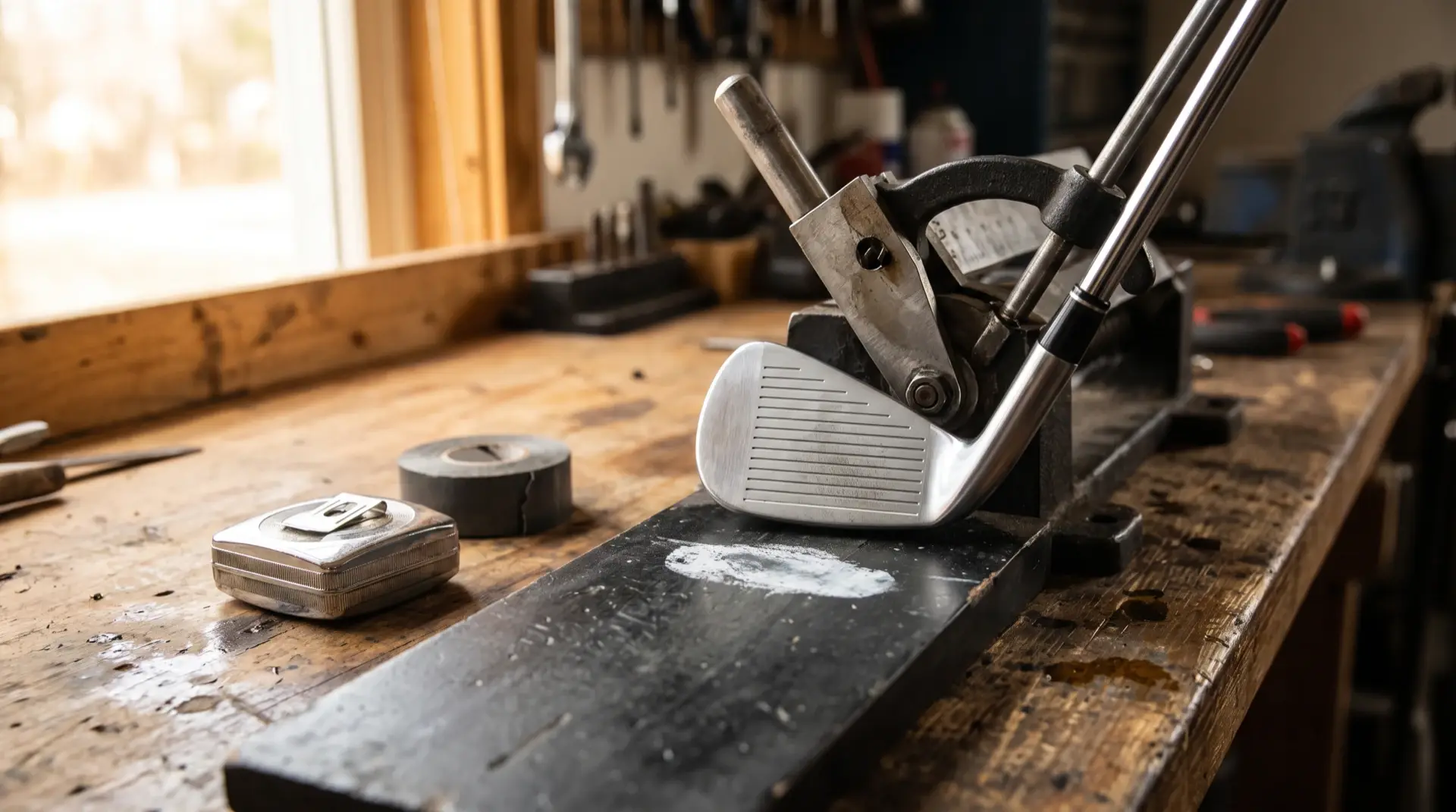
| Lie angle | Impact tape or a lie board shows whether the sole strikes toe-down or heel-down | Degrees per club, or a Ping color code |
| Length | Height and wrist-to-floor, then checked against strike location | Standard, or a build increment like +½” |
| Loft | Loft gauge, plus launch and spin off the monitor | Degrees per club, or a hosel setting |
| Shaft flex | Club speed, tempo, transition, launch, and dispersion | L, A, R, S, X, or a named shaft profile |
| Shaft weight | Speed and strike compared across weights | Grams, alongside shaft model |
| Head model | Strike pattern against forgiveness, spin, and launch | Model, handedness, loft |
| Grip size | Hand size, then validated by release and feel | Grip model plus tape build, like “midsize +2 wraps” |
| Set makeup | Carry gaps and whether you can launch each club | Club-by-club composition, like 5-hybrid through PW |
A fitting reads what your swing already does, then moves the club to meet it. The swing itself stays where it is.
The order matters. Lie and length come first because they change where the face points at impact, and a face aimed off by the geometry of the club is not something a shaft change fixes. How far that pushes the shot offline scales with loft, so the same lie error costs you more with a wedge than with a 5-iron. Be careful with the 4-yards-per-degree rule you’ll see repeated online; the geometry it comes from is rarely shown, and the number moves with every club in the bag.
What a golf club fitting chart looks like
Two different things share the name, and golfers searching for one usually want the other.
The static chart maps body measurements to a starting spec. Ping’s color code chart is the best known: height runs across the top, wrist-to-floor runs down the side, and the color where they cross is your recommended lie code. Black is standard. The chart covers golfers from 5’0” to 6’7”, and Ping’s published lie angles are quoted against the Black code at standard length, so the color modifies a baseline rather than replacing it. Measure in golf shoes or the number is wrong before you start.
The build sheet is what a fitting produces. It reads like a parts list:
6-iron through PW: selected head, +½” over standard, 1° upright, standard loft, 105g stiff shaft, midsize grip, D2 swing weight.
Ask for that sheet in writing. It is the document any shop needs to bend, re-shaft, or rebuild your set three years from now, and plenty of golfers walk out with a receipt and a verbal summary instead.
What the numbers say a fitting is worth
MyGolfSpy pulled the last 200 fittings conducted at Ping and compared each golfer’s fitted 7-iron against the one they walked in with. The fitted club gained about 10 yards, ball speed went up 5 mph, and the dispersion area shrank 30% on average.
Their driver study ran the same comparison: 9.5 more yards of carry, about 11 more total, and a 25% smaller dispersion area.
Two other tests point the same direction with different methods:
| Test | Sample | Result |
|---|---|---|
| Golf Digest driver fitting | 10 golfers, own driver vs fitted | All 10 gained yardage, 14 yards on average |
| Plugged In Golf / Club Champion | 25 full-bag fittings | All 25 gained driver distance, 16+ yards on average. 15 of 22 improved accuracy, group finished 5+ yards closer to the centerline |
Read the Club Champion figures with one eye open. The fittings were run by the company that sells the clubs, there was no control group, and any golfer who books a full-bag session arrives motivated. The direction is consistent across all four; the size of it is a range rather than a promise.
The dispersion numbers deserve more attention than the yardage ones. A club that flies 10 yards farther on your best strike is worth something. A club whose shot pattern covers 30% less ground is what turns a good number into a club you can trust on the 17th tee. MyGolfSpy measured a shrink in both studies: 30% with the irons, 25% with the driver.
Golf club fitting for beginners: get fit or wait?
Get fit for the broad specs. Skip the full-bag session until the swing settles.
A beginner handed a driver that is too long and too heavy is fighting it before they’ve made a swing, and no amount of range time fixes a length and weight mismatch. Length, total weight, shaft weight, loft, grip size, and a forgiving head are the stable specs. They keep working while the swing is still changing.
An exact shaft profile is not stable. A new golfer’s tempo, transition, and release change month to month, and a prescription tuned to this month’s delivery stops fitting before you notice.
MyGolfSpy’s 2024 fitting survey found the two most common reasons golfers skip it, and both are worth arguing with:
- Over 40% said it costs too much. PGA Tour Superstore runs Fit & Go and Express Bay sessions for free with no appointment, and Club Champion currently drops a full-bag fitting from $400 to $100 if you buy custom clubs from the session.
- 30% said they weren’t good enough. The Ping study that produced the 10-yard iron gain drew from ordinary customers walking into a Ping fitting bay.
Irons were the most-fitted category in that survey, at nearly 92% of fitted golfers. Woods and wedges trail it, so if you have been fit once, irons are the likeliest club you were fit for, and the rest of the bag is worth asking about next time.
Online golf club fitting: what a form can and can’t see
An online fitting is a recommendation engine. It takes your height, wrist-to-floor, hand size, handicap, current clubs, and self-reported ball flight, then returns a shortlist of heads, shafts, lofts, and lengths.
That is useful for narrowing a purchase. Ping’s WebFit positions itself as a starting point, with hitting real shots in front of a fitter as a separate stage, and taking the tool at its own word is the right move.
What a form never sees: where you strike the face, your delivered lie at impact, face-to-path, launch, spin, peak height, descent angle, or dispersion. Those are the measurements that separate “this club is playable” from “this club is better than yours.”
Mizuno’s Shaft Optimizer is the exception, because its input is a measured swing rather than a questionnaire. Three swings with an instrumented club capture over 40 data points, eight of which drive the shaft and lie recommendation, and the software returns three shafts to test from a database of more than 50, plus a lie angle and a set makeup. It still hands you a shortlist to go hit and compare.
If you’re doing a remote fitting, the quality of the output tracks the quality of what you send:
- Measured height and wrist-to-floor, in golf shoes, with a tape measure.
- A real swing speed number, not an estimate from your driver distance.
- Down-the-line and face-on video, which is what lets a human fitter see delivery.
- Your typical miss, described honestly. Best-shot distance tells a fitter nothing.
- Impact tape or face spray photos, so strike location stops being a guess.
What a fitting costs and how long it takes
From free to $475, and from 45 minutes to 3 hours.
| Where | Session | Price | Time |
|---|---|---|---|
| PGA Tour Superstore | Fit & Go / Express Bay | Free, no appointment | Walk-in |
| PGA Tour Superstore | Driver, iron, or putter | $99.99 | 75 min |
| PGA Tour Superstore | Full bag | $299.99 | 3 hrs |
| Club Champion | Driver | $175 | 1.5 hrs |
| Club Champion | Full bag | $400 | 3 hrs |
| True Spec | Full bag | $375 | Not published |
| True Spec | Full bag with putter | $475 | Not published |
Those numbers are the fitting fee alone. The clubs themselves are a separate invoice.
Two ways to spend less. Book the category you’re replacing rather than the full bag, since one category at $99.99 costs a third of the full-bag fee. And ask whether the fee is credited against a purchase before you book, since Club Champion has listed a full bag at $100 that way, though those offers carry booking deadlines.
The full price comparison, including Cool Clubs and what a fitted set costs after the session, is in our golf club fitting cost breakdown.
The gap a fitting can’t keep closed
A fitting measures one afternoon. Your gaps drift for years afterward.
The build sheet locks your specs, and specs don’t move. Carry distances do. Speed changes with the season and your age, a new ball changes wedge spin, and the 7-iron you were fit for in April is a different club in October when the ground is soft and the air is cold. Arccos looked at more than 6 million approach shots and found 40% finished short of the green against 5% long, and a fitting measures your carries once, indoors, on the day you showed up.
So a fitting answers “are these the right clubs for my swing” and leaves “how far do I actually hit each one, today” open. Both questions cost strokes when you get them wrong.
That second question is the one the MyBagCaddie bag audit answers: four questions, 60 seconds, and every gap and overlap in your bag named in yards and ranked by what it costs. No launch monitor, no appointment. A fitting is about $300 and a Saturday; the audit is free to run, and Pro is $9.99 a year or $49.99 once for life. It updates as your numbers change instead of going stale on a build sheet.
They do different jobs. Get fit when you’re buying clubs. Audit the gaps when you’re not.
For deeper dives
- Golf club fitting cost: what every national fitter charges, which sessions are free, and what the clubs cost after the fee.
- Golf club distance chart: the measured carry numbers for every club by handicap, which is the baseline a fitting is trying to move.
- How to find your real club distances: the median-carry method for turning launch monitor numbers into yardages you can play by.
- Golf bag setup: what 14 clubs to carry once the specs are settled, and where set makeup usually goes wrong.
- Golf club lofts and distances: what a degree of loft is worth in yards, and why modern iron sets are stronger than the set you learned on.
Key takeaways
- A fitting measures 8 specs: lie, length, loft, shaft flex, shaft weight, head model, grip size, and set makeup. None of them are about your swing.
- Across 200 Ping fittings, the fitted 7-iron gained about 10 yards and shrank the dispersion area 30% (MyGolfSpy).
- The tighter shot pattern matters more than the extra yards: MyGolfSpy measured the dispersion area shrinking 30% with fitted irons and 25% with fitted drivers.
- Beginners should get fit for the stable specs (length, weight, loft, grip, forgiveness) and skip the precise shaft prescription until the swing settles.
- Online fitting narrows models well and prescribes exact specs badly, because a form can’t see strike location, delivered lie, or dispersion.
- Over 40% of never-fitted golfers say it costs too much, but PGA Tour Superstore’s Fit & Go and Express Bay sessions are free and need no appointment.
- A fitting fixes your clubs once. Your carry gaps keep moving, so re-check the ladder a few times a year.
Frequently asked questions
- What does a golf club fitting measure?
- Eight specs, roughly in this order: lie angle, club length, loft, shaft flex or profile, shaft weight, head model, grip size, and set makeup. The fitter gets there with a tape measure for your height and wrist-to-floor, impact tape or a lie board to see where the sole strikes, and a launch monitor to read speed, launch, spin, and dispersion. The output is a build sheet with a number for every club.
- What is a golf club fitting chart?
- Two different things share the name. A static chart maps your height and wrist-to-floor measurement to a starting lie and length, like Ping's color code chart. A fitting chart can also mean the build sheet you leave with: head model, loft, lie, finished length, shaft model and flex, shaft weight, grip size, and swing weight for every club. The static chart is where a fitting starts; the build sheet is what it produces.
- Is a golf club fitting worth it for a high handicapper?
- Yes. MyGolfSpy's review of 200 fittings at Ping found the fitted 7-iron carried about 10 yards farther with the dispersion area 30% smaller, drawn from ordinary customers rather than tour players. Handicap changes how precise the prescription should be. A 20 handicap gets most of the benefit from length, total weight, loft, and a forgiving head, and less from chasing an exact shaft profile that a still-changing swing will outgrow.
- Should beginners get fitted for golf clubs?
- Yes for the broad specs, no for a full-bag session. A beginner swinging a club that is too long, too heavy, too stiff, or too strong in loft is fighting the equipment while learning. A basic driver or iron fitting fixes that in about an hour. Save the 3-hour full-bag session for after your swing settles, because a precise prescription built on an unstable delivery goes stale fast.
- Does online golf club fitting work?
- For narrowing models and getting a sane starting spec, yes. For an exact prescription, no. A web form takes your height, wrist-to-floor, hand size, handicap, and self-reported ball flight, then returns a shortlist. It never sees where you strike the face, your delivered lie, face-to-path, launch, spin, or dispersion. Ping positions WebFit as a starting point, with hitting real shots in front of a fitter as a separate stage, and that is the honest framing.
- How long does a golf club fitting take?
- One club takes 45 to 90 minutes and a full bag takes 2.5 to 3 hours. Club Champion publishes 1.5 hours for a driver and 3 hours for a full bag. PGA Tour Superstore lists 75 minutes for a driver and 3 hours for a full bag. Book the full session only if you plan to change several clubs, since fitting a driver you are not replacing burns an afternoon for nothing.
- How much does a golf club fitting cost?
- From free to about $475. PGA Tour Superstore runs free Fit & Go and Express Bay fittings with no appointment, and charges $99.99 for a 75-minute driver session or $299.99 for a full bag. Club Champion lists $175 for a driver and $400 for a full bag. True Spec charges $375 for a full bag, $475 with a putter. Many fitters credit the fee against a club purchase.