
Club distances 9 min read
Golf Club Distance Chart for Women
Shot Scope's tracked distances for women by club and handicap, how they line up against the LPGA Tour, and the gaps that hide in an off-the-rack set.
By Garrett Pierson
Quick answer
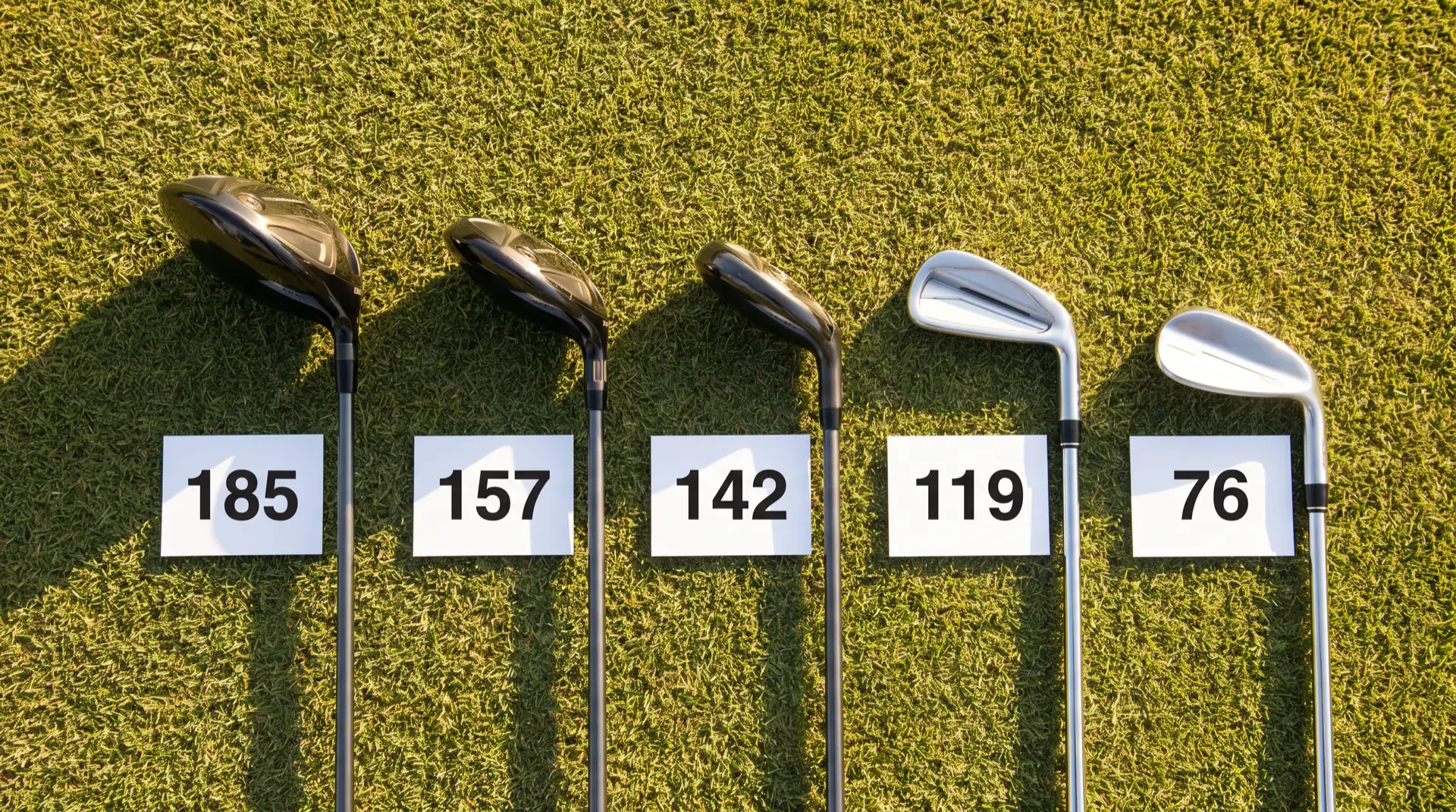
Shot Scope’s tracked women’s rounds put a 15 handicap at 185 yards with driver, 119 with a 7-iron, and 76 with a pitching wedge. A scratch woman averages 237 off the tee. Women hit 54% to 60% of fairways at every handicap, against roughly 47% to 49% for men. The gap between a scratch woman’s 4-hybrid and 5-hybrid is 24 yards. At a 30 handicap it’s 2.
Golf club distance chart for women
| Club | 0 | 5 | 10 | 15 | 20 | 25 | 30 |
|---|---|---|---|---|---|---|---|
| Driver | 237 | 222 | 204 | 185 | 174 | 167 | 152 |
| 3-wood | 210 | 195 | 173 | 157 | 147 | 138 | 131 |
| 5-wood | 206 | 181 | 164 | 146 | 143 | 133 | 124 |
| 7-wood | 181 | 170 | 151 | 139 | 137 | 128 | 118 |
| 4-hybrid | 199 | 168 | 152 | 142 | 131 | 129 | 118 |
| 5-hybrid | 175 | 158 | 148 | 133 | 127 | 124 | 116 |
| 5-iron | 176 | 153 | 144 | 140 | 124 | 120 | 114 |
| 6-iron | 167 | 145 | 138 | 129 | 118 | 114 | 109 |
| 7-iron | 156 | 138 | 126 | 119 | 107 | 103 | 98 |
| 8-iron | 149 | 126 | 118 | 110 | 98 | 94 | 88 |
| 9-iron | 138 | 117 | 108 | 95 | 85 | 86 | 79 |
| Pitching wedge | 129 | 99 | 87 | 76 | 69 | 66 | 63 |
| Gap wedge | 103 | 80 | 72 | 64 | 62 | 56 | 55 |
| Sand wedge | 94 | 53 | 48 | 46 | 41 | 41 | 42 |
| Lob wedge | 71 | 40 | 37 | 37 | 35 | 35 | 30 |
Column headings are handicaps. Source: Shot Scope’s women’s dataset as published by MyGolfSpy on 8 April 2026. It’s the first women’s set either company has broken out club by club and handicap by handicap that we could find. Shot Scope reports performance averages, which strip roughly 10% of extreme outliers, so a round full of mishits doesn’t drag the number down.
Two things in that table deserve suspicion. The 9-iron row has a 25 handicap (86) beating a 20 handicap (85), which is noise in the sample. And the wedge rows fall off a cliff below scratch: a 5 handicap woman’s sand wedge is listed at 53 yards against 94 for a scratch player. A 41 yard drop between two very good golfers reads like partial swings mixed into one average. Use the wedge rows as a rough shape and measure your own full carries.
The men’s version of this chart, scratch through 25 handicap, lives in our golf club distance chart.
The two Shot Scope cuts disagree, and that’s fine
Shot Scope has published women’s data twice, and the numbers don’t match.
| Club | 2025 banded cut | 2026 per-handicap cut |
|---|---|---|
| Driver, scratch | 252 | 237 |
| Driver, 26+ / 30 | 166 | 152 |
| 7-iron, scratch | 160 | 156 |
The 2025 release, reported by MyGolfSpy and by Golf Monthly, grouped players into bands: scratch or better, 1 to 5, 6 to 10, and so on. The 2026 release reports single handicap numbers. A “scratch or better” band pulls in plus handicaps and drags the top row up, which explains most of the 15 yard driver difference.
Read either one as a band with 10 yards of slop in it. Golf Monthly’s summary of the same dataset says the average driving distance for a female handicap golfer is 177 yards, and Arccos independently measured women at 176.2 across more than four million rounds played in 2024. When two companies with different sensors and different user bases land within a yard of each other, that middle number is solid. The per-club rows around it are softer.
Women hit more fairways than men at every handicap
| Handicap | Women, fairways hit |
|---|---|
| Scratch or better | 60% |
| 1-5 | 54% |
| 6-10 | 55% |
| 11-15 | 56% |
| 16-20 | 58% |
| 21-25 | 59% |
| 26+ | 56% |
A 21 to 25 handicap woman finds 59% of fairways off a driver that goes 178 yards, against the 224.7 yard male average Arccos measured across 2024. She gives up 47 yards and still finds the short grass more often. MyGolfSpy’s write-up of the same dataset puts men closer to 47% to 49%, though that men’s figure comes as prose rather than a published table, so treat the exact size of the gap as directional.
The direction changes what the second shot looks like. A player finding 59% of fairways is standing on short grass more often than not, holding a club that has to cover 140 yards. Whether she owns a club that covers 140 yards is a different question from how far she drives it, and it decides more holes.
LPGA Tour numbers, and the carry trap inside them
TrackMan’s 2024 tour averages, laid out by Golf Monthly:
| Club | Club speed | Ball speed | Carry |
|---|---|---|---|
| Driver | 96 mph | 143 mph | 223 yds |
| 3-wood | 92 | 135 | 200 |
| 5-wood | 90 | 130 | 189 |
| Hybrid | 87 | 125 | 178 |
| 4-iron | 82 | 118 | 175 |
| 5-iron | 81 | 114 | 166 |
| 6-iron | 80 | 111 | 155 |
| 7-iron | 78 | 106 | 143 |
| 8-iron | 76 | 102 | 133 |
| 9-iron | 74 | 95 | 123 |
| Pitching wedge | 72 | 88 | 111 |
An LPGA player carries a 7-iron 143 yards. Shot Scope’s older banded cut puts an 11 to 15 handicap woman’s 7-iron at 141 yards of total distance. Those look like the same club. One number stops where the ball lands. The other includes every yard of roll on a firm fairway.
Carry is what clears the bunker. Total is what you find when you walk up to the ball. Charts mix the two constantly, and outlets label the same Shot Scope dataset inconsistently, so the safest habit is to compare tour carry to your carry and club-golfer totals to your totals. Our guide to finding your real club distances covers how to measure the one that matters.
A scratch woman and a bogey man swing 2 mph apart
TrackMan’s Combine averages, published on its club speed page, put driver speed at:
| Player | Driver club speed |
|---|---|
| Female, scratch or better | 90 mph |
| Female, 5 handicap | 87 mph |
| Female, 10 handicap | 83 mph |
| Female, 15 handicap | 79 mph |
| Male, bogey golfer | 92 mph |
| Male, 14.5 handicap | 94 mph |
| LPGA Tour | 96 mph |
| PGA Tour | 115 mph |
A scratch woman at 90 mph and a bogey man at 92 mph are two players with nearly identical clubhead speed. One of them usually gets handed a ladies flex in a boxed set. The other gets fitted for regular or stiff. Speed doesn’t read the label on the shaft, so if your driver swing is above 85 mph it’s worth asking a fitter whether the shaft in your bag is the one your speed calls for.
TrackMan also notes that 1 mph of extra club speed can be worth up to 3 yards with a driver. The 11 mph between a 15 handicap woman and a scratch woman is worth up to 33 yards on that math, which covers about two thirds of the 52 yard driver gap in the chart above. Better strike and launch cover the rest.
Age moves the driver number 41 yards
Arccos analyzed 6.5 million shots from a random sample of 25,000 users across the 2024 season, summarized by GolfBusinessNews. Women in their 20s averaged 201.1 yards off the tee. Women in their 60s averaged 160. That’s 41 yards.
The accuracy numbers flip. The 60s group hit 62% of fairways. The 20s group hit 45%.
Two golfers, one bag full of clubs each, and completely different problems. The 25 year old needs a wedge she can land on a number. The 65 year old needs something that gets airborne from 160 yards, usually a 7-wood or a high-lofted hybrid. The 5-iron the set shipped with won’t do it.
The gaps hiding in a women’s set
Fitters aim for 10 to 15 yards between consecutive clubs. Look at what the chart does to that spacing as the handicap climbs.
Hybrids collapse first. A scratch woman has 24 yards between her 4-hybrid (199) and 5-hybrid (175). A 30 handicap has 2 yards between hers (118 and 116). Two clubs, one yardage, one wasted slot.
Fairway woods bunch right behind them. Scratch: 3-wood 210, 5-wood 206, 7-wood 181. Even at the top of the game, the 3-wood and 5-wood are 4 yards apart. At a 20 handicap it’s 147, 143, and 137, which is three clubs covering 10 yards.
Then the top of the bag splits open. A 25 handicap woman hits driver 167 and a 3-wood 138. That’s a 29 yard hole, double the spacing a fitter aims for, and it sits on the shot she plays most. Underneath it her 3-wood (138), 4-hybrid (129) and 5-iron (120) are stacked 9 yards apart.
Off-the-rack women’s sets tend to ship one spec to a 90 mph golfer and a 79 mph golfer. One of them has real spacing. The other has duplicates in the middle and a hole at the top. Which one you have is a question your own yardages answer in about a minute.
Replace the chart with your own numbers
Every row above is an estimate until you measure. The method is one range session: hit 8 to 10 normal shots with a club, throw out the true mishits, and take the median carry instead of the average, since one flushed shot drags an average up by yards it can’t repeat.
The MyBagCaddie bag audit starts from handicap-based estimates like the table above, then the Carry Log replaces them with what you actually hit, three taps per shot and no launch monitor needed. It checks all 14 slots in about 60 seconds and names every gap and overlap in yards. The free version is four questions and hands back a BagScore with a ranked problem list.
For deeper dives
- Golf club distance chart: the men’s dataset, scratch through 25 handicap, driver to lob wedge.
- How to find your real club distances: the median-carry method behind an honest chart.
- Hybrid golf club distances: how each hybrid stacks up against the long iron it replaces.
- Golf wedge distances chart: full, three-quarter, and half carries, and how to gap the short end.
- Golf bag setup: which 14 slots deserve a club once you know your yardages.
Key takeaways
- Shot Scope’s 2026 women’s chart puts a 15 handicap at 185 with driver, 119 with a 7-iron, and 76 with a pitching wedge.
- Average female driver distance is about 176 to 177 yards, confirmed independently by Arccos and Shot Scope.
- Women hit 54% to 60% of fairways at every handicap in Shot Scope’s data. Men sit closer to 47% to 49%.
- LPGA players carry a 7-iron 143 yards. A good club golfer’s 141 yard 7-iron is total distance, roll included.
- A scratch woman swings the driver at 90 mph and a male bogey golfer at 92, which makes the ladies flex default worth questioning.
- Hybrid spacing collapses from 24 yards at scratch to 2 yards at a 30 handicap, and the fairway woods bunch right behind them.
Frequently asked questions
- How far does the average woman hit a driver?
- Between 176 and 177 yards, and the two big tracking companies land within a yard of each other. Arccos measured women at 176.2 yards off the tee across more than four million rounds played in 2024. Shot Scope puts the average female handicap golfer at 177. By handicap, Shot Scope's 2026 cut runs from 237 yards at scratch down to 152 at a 30 handicap, an 85 yard spread across the range.
- How far should a woman hit a 7-iron?
- Around 119 to 141 yards at a 15 handicap, depending on which Shot Scope cut you read. The 2026 per-handicap chart says 119 for a 15, while the older banded chart puts the 11 to 15 group at 141. Both are on-course totals with roll included, not measured carry. For reference, LPGA Tour players carry a 7-iron 143 yards on TrackMan data, so a good club golfer's total distance can look like a tour player's carry number.
- What is the average golf club distance chart for women by handicap?
- Shot Scope released a full women's set in 2026 covering driver through lob wedge at seven handicap levels. A 15 handicap sits at 185 with driver, 157 with a 3-wood, 142 with a 4-hybrid, 140 with a 5-iron, 119 with a 7-iron, and 76 with a pitching wedge. A scratch player is 52 to 57 yards longer with driver, 3-wood and 4-hybrid, and 36 yards longer with a 5-iron. Read every row as a starting estimate, then replace it with your own median carry.
- Do women hit more fairways than men?
- Yes. Shot Scope's tracked rounds show women hitting 54% to 60% of fairways across every handicap band. Scratch women lead at 60% and the 26-plus group still finds 56%. MyGolfSpy's write-up of the same data puts men closer to 47% to 49%, a comparison made in prose rather than a published men's table, so read the exact gap as directional. Arccos data shows the same shape by age: women in their 60s hit 62% of fairways while averaging 160 yards off the tee, and women in their 20s hit 45% while averaging 201.
- What swing speed does a woman need to hit a driver 200 yards?
- Somewhere around 83 mph, based on how the two datasets line up. TrackMan's Combine averages put a 10 handicap woman at 83 mph with driver, and Shot Scope's tracked rounds put that same 10 handicap at 204 yards off the tee. TrackMan also notes that adding 1 mph of club speed can add up to 3 yards with a driver. Strike quality and launch conditions move the number as much as speed does, so treat the conversion as a rough guide.
- Should women play a ladies flex shaft?
- Not automatically. TrackMan's Combine data has a scratch or better woman swinging the driver at 90 mph and a male bogey golfer at 92, which is a 2 mph difference between two players who typically get sold completely different shafts off the rack. Flex should follow your measured speed and strike pattern. Get on a launch monitor before you accept the default that comes in a boxed set.
- How much distance do women lose with age?
- About 41 yards off the tee between a golfer in her 20s and one in her 60s. Arccos measured women in their 20s at 201.1 yards and women in their 60s at 160 across 2024 rounds. That's roughly 10 yards a decade. Accuracy runs the other direction: the 60s group hit 62% of fairways against 45% for the 20s group.