
Club distances 9 min read
Driver Distance: How Far the Average Golfer Hits It
The average male amateur drives it 224 yards, unchanged since 2018. Driver distance by handicap, age and swing speed, from millions of tracked tee shots.
By Garrett Pierson
Quick answer
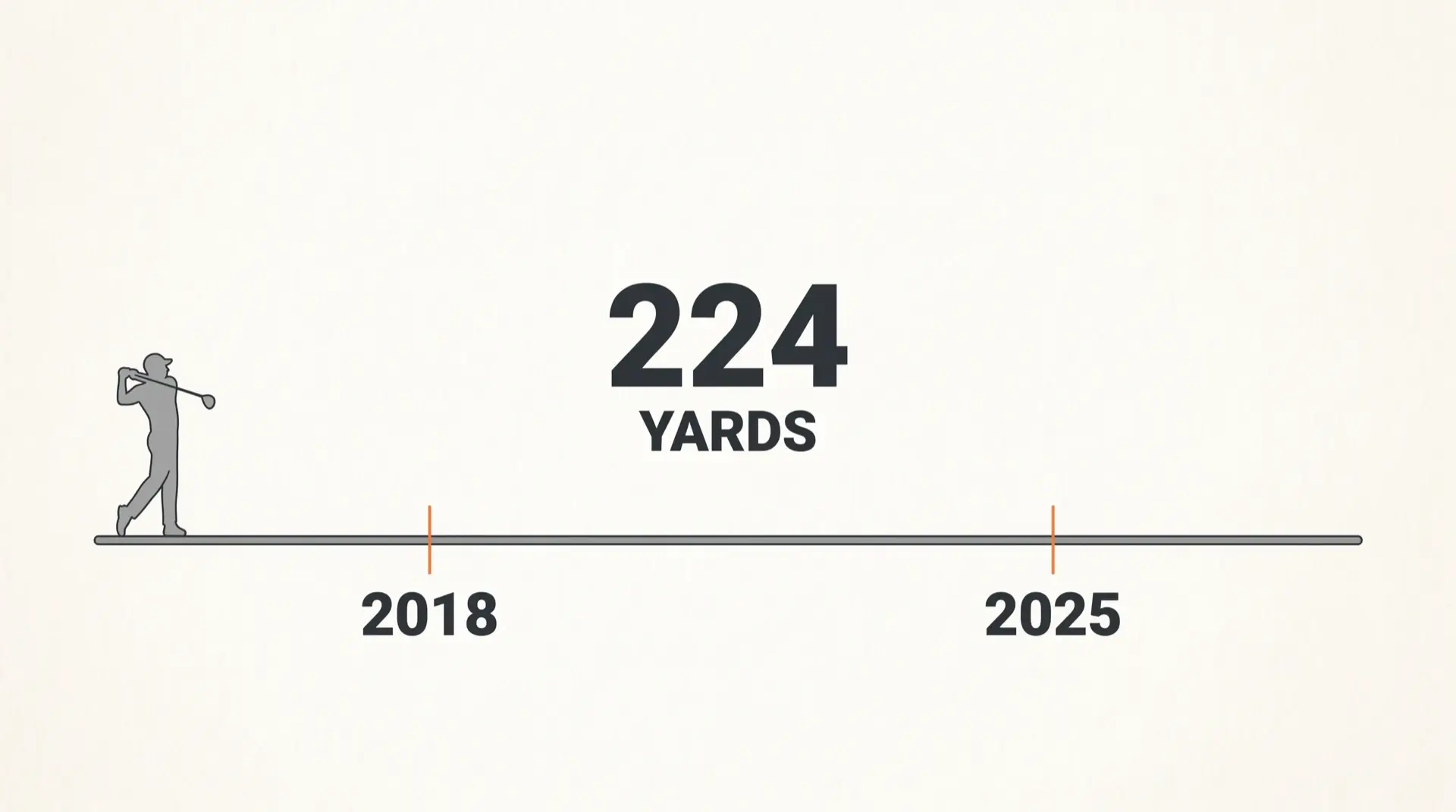
Across the 2025 season the average male amateur drove it 224 yards and the average woman 176. The men’s figure has not moved since 2018, across nearly 10 million tracked tee shots; the women’s has drifted down about 3.5 yards. By handicap it runs from 244 yards at scratch-to-4.9 down to 181 at 30-plus. Clubhead speed sets the ceiling; how centered you strike it sets how close you get to that ceiling.
Driver distance by handicap and age: men
Find your handicap row, then your age column. Every figure is total distance in yards, published by Arccos from tracked tee shots on par 4s and par 5s.
| Handicap | 15-19 | 20s | 30s | 40s | 50s | 60s | 70s |
|---|---|---|---|---|---|---|---|
| +0.1 or better | 269 | 271 | 269 | 259 | 250 | 234 | 213 |
| 0.0 to 4.9 | 259 | 265 | 262 | 253 | 241 | 227 | 209 |
| 5.0 to 9.9 | 244 | 254 | 251 | 242 | 230 | 217 | 201 |
| 10.0 to 14.9 | 236 | 241 | 239 | 228 | 219 | 207 | 191 |
| 15.0 to 19.9 | 220 | 229 | 227 | 218 | 209 | 196 | 181 |
| 20.0 to 24.9 | 211 | 219 | 216 | 207 | 200 | 186 | 168 |
| 25.0 to 29.9 | 205 | 210 | 208 | 200 | 190 | 178 | 165 |
| 30.0+ | 192 | 200 | 196 | 189 | 181 | 166 | 155 |
Two things fall out of the grid. Distance peaks in the 20s in all eight handicap rows, and a scratch player in his 70s (213) drives it past a 30-handicapper in his twenties (200). Age costs more than most golfers plan for, and skill buys more than they expect.
This grid is Arccos’s 2023 breakdown, the most recent one it charts openly rather than behind a report download. It has barely aged.
Take the 0.0 to 4.9 row. Cells reported from the 2026 edition, built on 2025 rounds, come in at 263 in the 20s, 253 in the 40s, 227 in the 60s and 209 in the 70s. The grid above says 265, 253, 227 and 209. Three of the four are identical.
Driver distance by handicap and age: women
| Handicap | 20s | 30s | 40s | 50s |
|---|---|---|---|---|
| 0.0 to 4.9 | 246 | 238 | 231 | 203 |
| 5.0 to 9.9 | 226 | 231 | 214 | 194 |
| 10.0 to 14.9 | 217 | 209 | 194 | 181 |
| 15.0 to 19.9 | 189 | 192 | 185 | 170 |
| 20.0 to 24.9 | 193 | 176 | 165 | 157 |
| 25.0 to 29.9 | 169 | 164 | 154 | 146 |
| 30.0+ | 167 | 151 | 146 | 135 |
Arccos publishes four age bands for women rather than seven, because the teen, 60s and 70s samples are too thin to chart. The 20s column also wobbles: 193 yards at a 20 to 24.9 handicap sits above 189 at a 15 to 19.9, which is what a small sample looks like. Read the columns for their shape, not to the yard.
Eight years, less than a foot
The average male amateur drove it 224.0 yards in 2018. In 2025 he drove it 224.1.
That is the finding of Arccos’s eighth Annual Driving Distance Report, drawn from nearly 10 million driver tee shots hit in real rounds. Eight years of new drivers, better fitting, speed training and launch monitors in every pro shop, and the recreational average moved less than a foot.
Women went the other way, from 179.2 yards in 2018 to 175.7 in 2025.
Professionals are the exception. PGA Tour players averaged 302.8 yards in 2025, the LPGA Tour 259.8, and the Korn Ferry Tour was longest of all at 308.4, per the USGA and R&A. Tour distance has crept up about a yard a year for a decade, which is the entire reason a reduced-distance ball arrives in 2030.
Why two databases disagree by 41 yards
Arccos has a scratch-to-4.9 golfer at 244 yards. Shot Scope has a scratch golfer at 285. Same club, same sport, 41 yards apart.
The methods explain it. Arccos samples driver tee shots on par 4s and par 5s and reports where the ball stopped, thin ones and blocked ones included. Shot Scope publishes a Performance Average that strips outliers to show what you hit when you execute.
One answers “how far do I hit it,” the other answers “how far do I hit a good one.” Read the Shot Scope rows as what a good drive looks like and the Arccos rows as what to plan a hole around, and never mix a number from one into a chart from the other.
Arccos also leaves conditions in rather than scrubbing them out. A representative 10-handicap averages 220.5 yards at sea level and 239.7 above 5,000 feet. If you play in Denver, the grid is reading someone else’s golf.
Shot Scope’s own distribution puts a floor under both: nearly 70 percent of amateurs average under 250 yards, and the single largest group sits between 200 and 224.
What age actually costs
Across all handicaps, Arccos’s 2026 report has men in their teens at 240 yards and men in their 70s at 190, and it found every skill level sliding at roughly the same rate.
That headline puts teenagers on top, while the grid has the 20s peaking in every handicap band. Both hold, because the teenagers who buy shot tracking skew low-handicap, so their all-in average is pulled up by who is in the sample rather than by age. Inside any one skill band, the 20s win.
The grid above shows where those 50 yards go. A 10 to 14.9 handicap loses 50 yards between his 20s and his 70s, and a scratch player loses 58. The decline is slow enough to hide inside a single season, which is how golfers end up playing a yardage they set ten years ago and wondering why the ball keeps finishing short.
Losing those yards is not the same as getting worse. Over the same span that low-handicap men drop 54 yards, their fairways-hit rate climbs from 42 percent to 60 percent. The 65-year-old three-handicap measuring himself against his 25-year-old self is using the wrong yardstick, and the wrong yardages.
Clubhead speed sets the ceiling
TrackMan’s Combine data puts driver club speed at:
| Player | Club speed |
|---|---|
| PGA Tour | 115 mph |
| LPGA Tour | 96 mph |
| Scratch or better (male) | 110 mph |
| 5 handicap | 101 mph |
| 10 handicap | 95 mph |
| Average golfer, 14.5 handicap | 94 mph |
| Bogey golfer | 92 mph |
TrackMan’s rule: “Adding 1 mph of Club Speed can increase your distance by up to 3 yards with the driver.” Read that as a marginal rate, not a multiplier. Five mph of new speed is worth up to 15 yards; it does not mean 94 mph equals 282 yards.
Look at the bottom four rows. A 10 handicap swings 95 mph, the average golfer 94, a bogey golfer 92. Three miles per hour covers the whole band, yet those players are nowhere near each other on the course. Raw speed is only part of what separates them.
Smash factor widens the gap
Smash factor is ball speed divided by club speed, which makes it a direct measure of how much of your swing reached the ball. TrackMan publishes it by handicap, and it falls as handicaps rise: 1.49 at scratch, 1.45 at a 5 and a 10, 1.44 for the average golfer, 1.43 for a bogey golfer.
Multiply the two tables together and the gap opens up:
| Player | Club speed | Smash | Ball speed |
|---|---|---|---|
| Scratch or better | 110 mph | 1.49 | 164 mph |
| 5 handicap | 101 mph | 1.45 | 146 mph |
| 10 handicap | 95 mph | 1.45 | 138 mph |
| Average golfer | 94 mph | 1.44 | 135 mph |
| Bogey golfer | 92 mph | 1.43 | 132 mph |
An 18 mph club speed gap between scratch and bogey becomes a 32 mph ball speed gap. The bogey golfer swings slower and then keeps less of what he swings. Carry follows ball speed, so that second loss costs him twice.
The LPGA hits up, everyone else hits down
LPGA Tour players average plus 2.8 degrees of attack angle with a driver. PGA Tour players average minus 0.9. Male amateurs are negative at every handicap TrackMan publishes, from minus 0.9 at scratch to minus 2.1 for a bogey golfer.
A teed ball is the only shot in golf you can hit on the way up. Doing so shrinks spin loft, the gap between dynamic loft and attack angle, which is what drops spin and lets you launch the ball high without ballooning it. That trade adds carry at a given club speed, which is why fitters chase it.
Every amateur band average in TrackMan’s table sits on the wrong side of zero. Ball forward, shoulders tilted slightly away from the target, and let the driver arrive on the way up.
What to do with your own number
- Take the median of 15 to 20 on-course drives. Drop the topped ones and the ones that went out of bounds. The measuring method is here.
- Write down carry separately. Total is what the GPS shows. Carry is what clears the bunker, and on a soft course carry is all you have.
- Check your gap to the 3-wood. A driver and 3-wood 10 yards apart means one of them is not earning its slot.
- Fix the strike before you chase speed. A bogey golfer at 1.49 smash instead of 1.43 gains 5.5 mph of ball speed without swinging any harder.
The MyBagCaddie bag audit takes your driver number along with the other 13 and names every gap in yards, so you can see whether the top of your bag is a ladder or a pile.
For deeper dives
- Golf club distance chart: every club from driver to lob wedge across six handicap levels.
- How to find your real club distances: the measuring method behind every number here.
- Golf club distance chart for women: the women’s rows in full, plus the LPGA comparison.
- Golf bag setup: what the other 13 slots should hold once the driver number is settled.
Key takeaways
- The average male amateur drives it 224 yards and has not gained a yard since 2018. The average woman drives it 176, down about 3.5 yards over the same span.
- Arccos and Shot Scope disagree by 41 yards at the low-handicap end because one counts every drive and the other counts good ones.
- PGA Tour average is 302.8 yards and rising about a yard a year; amateur distance is flat, which is the argument behind the 2030 ball rollback.
- From a 10 handicap down to a bogey golfer, club speed only moves 3 mph: 95, 94, 92.
- Smash factor widens that gap, turning 18 mph of club speed between scratch and bogey into 32 mph of ball speed.
- LPGA players average plus 2.8 degrees of attack angle at 96 mph, while every amateur band average TrackMan publishes is negative. Hitting up costs nothing but a setup change.
Frequently asked questions
- How far does the average golfer hit a driver?
- 224 yards for the average male amateur and 176 for the average woman, from Arccos data covering nearly 10 million tracked driver tee shots. Those are total distances, carry plus roll, measured on real courses rather than a launch monitor. Shot Scope's separate database agrees on the shape of it: nearly 70 percent of amateurs average under 250 yards off the tee, with the biggest single group sitting between 200 and 224.
- What is a good driver distance by handicap?
- Arccos puts men between scratch and 4.9 at 244 yards and men at 30-plus handicaps at 181, a 63-yard spread. Shot Scope's numbers run higher because they filter for well-struck shots, reaching 285 at scratch and 225 at a 20 handicap. Pick one database and stay in it. Comparing your Arccos number to a Shot Scope chart will flatter or gut you for no reason.
- How far should I hit my driver at my swing speed?
- There is no clean speed-to-yardage formula, because carry depends on strike, launch and spin as much as on speed. TrackMan's usable rule is marginal: adding 1 mph of club speed is worth up to 3 yards, so 5 mph of new speed is worth up to 15. For a reference point, the average male amateur swings 94 mph and averages 224 yards of total distance on course.
- What is the average PGA Tour driver distance?
- 302.8 yards in 2025, per the USGA and R&A Annual Driving Distance Report. The LPGA Tour averaged 259.8 and the Korn Ferry Tour was actually longest at 308.4. PGA Tour distance has crept up about a yard a year over the past decade, which is the trend behind the reduced-distance ball arriving in 2030. The male amateur average over the same period has not moved.
- Why is my driver distance shorter than the charts say?
- Usually because the chart is measuring something else. Launch-monitor charts report carry on a flat range with a perfect strike; Arccos reports where the ball actually stopped on a real course, mishits included. A chart built on well-struck shots only, like Shot Scope's, sits 30 to 40 yards above one built on every drive. Your number is fine. Check what the chart counted.
- Does driver distance drop with age?
- Yes, and fairly steadily. Arccos has men in their teens at 240 yards and men in their 70s at 190, a 50-yard drop, with every skill level losing distance at about the same rate. Arccos reports the same downward curve for women. The drop is gradual enough that most golfers keep playing yardages they set a decade earlier, which is a common reason approach shots start finishing short.
- How can I add distance to my driver?
- Strike quality first. TrackMan's smash factor averages run from 1.49 at scratch down to 1.43 for a bogey golfer, so a bogey golfer loses ball speed on top of swinging slower. Attack angle is the second lever: LPGA players average plus 2.8 degrees, hitting up on the ball, while amateurs average negative, which leaves them more spin loft, more spin and less carry. Swing speed added without centered contact usually shows up as a wider miss.